
Is information transfer within the regulatory system intact, or is it disturbed? Everything depends on connectivity.
In this article, André Dückers, founder of Energetic Structural Balance (ESB®), explains the thinking behind his approach, and why he believes bodywork practitioners need to look beyond individual structures to the networks that connect them.
The ESB cybernetic-causal approach views the human organism as a complex, self-organising system composed of interconnected and self-regulating control mechanisms.
Within this framework, the human body is a dynamic network of interactions that continuously creates, adapts and organises itself.
But what does this mean for the way we assess and treat the people who come to us with pain, restrictions or chronic complaints?
Looking beyond the clinical diagnosis
In ESB (Energetic Structural Balance), the primary focus is on the transfer of information throughout the organism and on disturbances that interfere with this communication.
Consequently, the cybernetic approach to assessment and treatment does not primarily start from the patient’s clinical diagnosis.
Cybernetics concerns the way complex systems regulate themselves through information, communication and feedback. Rather than considering individual components in isolation, it examines how they interact and influence the functioning of the system as a whole.
In principle, every chronic disorder is the result of multiple contributing factors.
Likewise, every regulatory system can be disrupted by numerous and often very different interfering influences.
From a cybernetic perspective, it is impossible to distinguish between “major” and “minor” disturbances within a regulatory network. The only relevant question is whether information transfer within that system is functioning properly or has become disturbed.
Furthermore, in non-linear systems, particularly those characterised by feedback loops, it is not meaningful to distinguish between primary and secondary causes.
All components continuously influence one another, making the concept of a single causal hierarchy inadequate.
This is an important difference from a purely structural approach, which may focus primarily on identifying and treating the anatomical structure associated with a complaint.
Within the cybernetic-causal approach, the question is not only which structure is affected, but how disturbances within the wider network may be influencing its function.
Meridians and the body’s regulatory systems
The organism possesses numerous regulatory mechanisms.
Within energetic medicine, these regulatory subsystems are referred to as meridians.
Traditional Chinese Medicine describes twelve primary meridians and eight extraordinary meridians.
Using Electroacupuncture According to Voll (EAV), Dr Reinhard Voll identified an additional eight meridians. These are commonly referred to as the Voll meridians.
Electroacupuncture According to Voll, is a method of electrodermal assessment developed by Dr Voll. It involves electrical measurements at specific points on the body.
Each meridian contains a series of acupuncture points, each of which was assigned an anatomical significance by Dr Reinhard Voll.
According to his model, every acupuncture point corresponds to a specific anatomical structure, such as a particular part of an organ, an endocrine gland, a joint, a muscle, a tonsil, a tooth, a paranasal sinus, a nerve, and many other tissues.
At first glance, these structures appear to be unrelated.
However, within this model they are considered to share the same vibrational pattern. This is a phenomenon that, in engineering, is referred to as resonance.
Understanding the resonance chain
Visualise these regulatory subsystems as a resonance chain.
Imagine a series of small spheres connected by a single chain.
It is impossible to set one sphere into motion without inducing movement in the others. The degree of resonance depends on the strength of the initiating impulse.
According to this principle of interconnectedness, a severely disturbed organ will inevitably influence the functioning of other organs within the same resonance chain.
The closer a structure is positioned to the source of the disturbance, the greater the intensity of the resonance and, consequently, the greater the functional disturbance.
This concept helps explain why, during Bowen Therapy, treating a single muscle influences not only that muscle itself, but also a range of other anatomically and functionally related structures.
Conversely, pathology affecting a particular organ, or even a single tooth, may alter muscle function, causing a muscle to become either hypertonic or inhibited.
This is why, within the ESB model, we consider structures that appear anatomically unrelated as part of the same functional regulatory network.
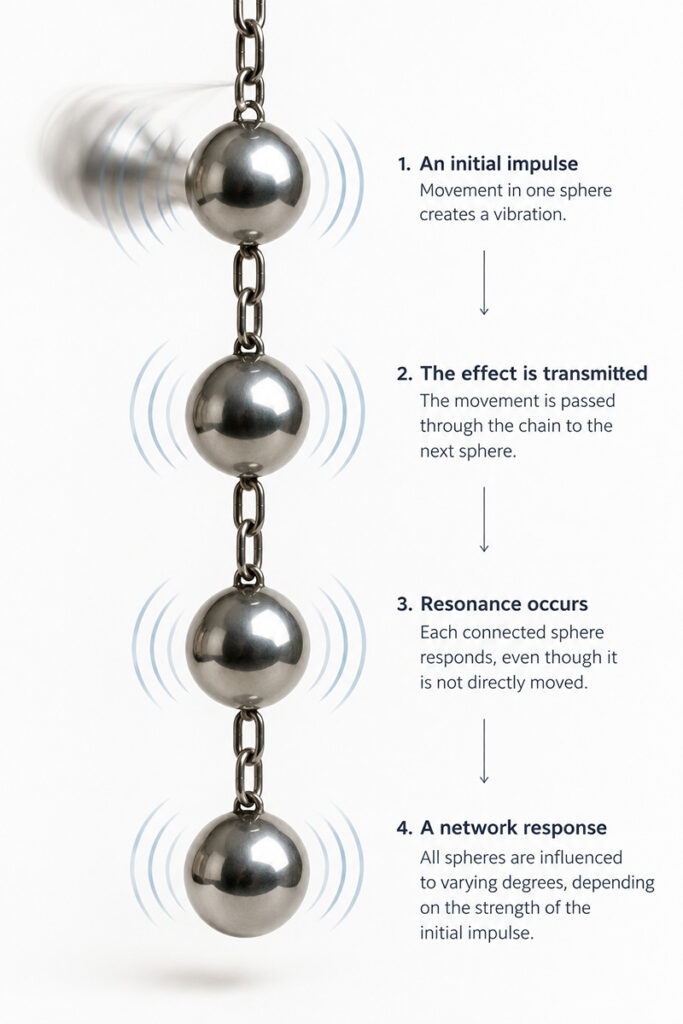
“It is impossible to set one sphere into motion without inducing movement in the others.”
Investigating body asymmetry: My observations in practice
Over many years I have investigated body asymmetry using Electroacupuncture According to Voll (EAV).
My conclusion has been that the body’s primary response to physiological stress is the development of asymmetry.
Whenever an interfering factor or stressor places a sufficient burden on the autonomic nervous system, the organism responds by developing a measurable asymmetry.
Within ESB, the position and mobility of the atlas (C1 vertebra, the uppermost vertebra of the spine) are assessed as an indicator of autonomic nervous system dysfunction and, consequently, of functional body asymmetry.
In today’s fast-paced society, every individual experiences multiple episodes of functional asymmetry each day.
Under normal circumstances, these transient imbalances are rapidly corrected through the body’s intrinsic self-regulatory mechanisms and adaptive behaviour.
Only when an interfering factor becomes chronic does the organism lose its capacity to compensate effectively.
At that stage, prolonged dysregulation may allow a functional disturbance to develop into structural pathology.
I explore how the body adapts, and why that adaptation can itself become the problem, in my latest blog, When Adaptation Becomes the Problem.
Is body asymmetry always a biomechanical problem?

A demonstration I frequently use at the beginning of ESB Module 1 illustrates that body asymmetry should not automatically be regarded as a biomechanical problem.
I always begin the course with a live demonstration, inviting a participant who presents with both a structural complaint and an underlying functional disturbance.
During the initial assessment, I demonstrate to the course participants that the individual exhibits clear body asymmetry.
From a purely biomechanical perspective, one would naturally assume that this asymmetry reflects a mechanical dysfunction.
Next, I place a nosode, a homeopathic preparation derived from pathological tissue, on the participant’s body.
The nosode is selected to correspond with the organ that is considered functionally disturbed within the ESB assessment.
Almost immediately, the previously observed asymmetry disappears.
When the nosode is removed, the asymmetry returns.
I usually repeat this procedure several times to demonstrate how rapidly body asymmetry can change under these test conditions.
It takes just a split second.
An example from Bowen College UK
One of the demonstrations during the 2026 course at Bowen College involved a participant who presented with a right-sided frozen shoulder together with signs interpreted within the ESB framework as liver dysfunction.
Following the assessment, I placed a liver nosode on the participant’s body.
The body asymmetry disappeared immediately, and she was once again able to move her shoulder freely.
I then combined treatment of the shoulder with an ESB visceral technique directed at the liver.
In this demonstration, within approximately thirty seconds, the participant reported that both the pain and the restriction of movement had eased.
At this point, most course participants assume that the problem has been solved and that the patient can simply return home.
This provides an opportunity to demonstrate the principle of the resonance chain, described earlier.
Further atlas testing revealed that stimulation of the canine teeth, the right palatine tonsil, and the right sphenoid sinus each reproduced body asymmetry.
Within the ESB model, these structures are considered to belong to the same functional regulatory network as the liver.
Consequently, each of these structures was also addressed during treatment, since persistent dysfunction within any one of them could, in principle, contribute to the recurrence of the shoulder symptoms.
In general, clinically relevant interfering factors place stress on multiple regulatory systems simultaneously.
From a cybernetic perspective, chronic disorders should therefore be regarded as fundamentally multicausal rather than the consequence of a single isolated cause.
When improvement is not the same as recovery
This brings us to an important implication of the cybernetic-causal approach.
The model predicts that removing just one randomly selected interfering factor may temporarily restore normal regulation within the affected system.
Following an ESB or Bowen treatment, this often becomes apparent as the restoration of stable body symmetry.
However, such an improvement should not automatically be interpreted as permanent recovery.
From a cybernetic perspective, lasting recovery implies the flawless functioning of all regulatory systems.
As long as multiple underlying disturbances remain present, even if they are temporarily compensated, the introduction of a single new stressor may be sufficient to trigger a renewed state of decompensation. This is a situation in which the organism is no longer able to compensate effectively for the demands placed upon it.
“Improvement should not automatically be interpreted as permanent recovery.”
What does this mean in practical terms for our therapeutic approach?
It means that restoring body symmetry, often accompanied by pain relief, in a patient with a chronic condition should never be interpreted as evidence that the patient has fully recovered.
Lasting recovery, defined cybernetically as the optimal functioning of all regulatory systems, requires the elimination of all clinically relevant interfering factors.
As therapists, we should therefore ask ourselves whether the symmetry observed immediately after treatment truly reflects complete recovery. Or, whether it merely represents the organism’s latest successful adaptation to a stressor.
In patients with chronic disorders, in my experience, the latter explanation is the more likely one.
This distinction can only be made by looking beyond the structural condition of the body and assessing the functional integrity of its regulatory systems.
Brain axes within ESB: Communication between the brain and organs
Traditional Chinese Medicine developed long before the functions of the brain and nervous system were understood as they are today.
In ESB therapy, however, the brain occupies a central role.
Contemporary neuroscience recognises the brain as the body’s overarching control system, and it would therefore seem incomplete to ignore its role during treatment.
Within the ESB framework, we aim to manually and selectively influence specific brain regions in order to optimise their functional activity.
The concept that the brain is intimately connected with the rest of the body is far from new.
Classical medicine recognised a close relationship between emotions, organ function, and physical health.
The humoral theories of Hippocrates and Galen, for example, proposed that health depended on maintaining a balance between the body’s fluids and emotional states.
During the nineteenth century, the modern concept of neuroendocrine regulation emerged.
Scientists such as Claude Bernard, with his concept of the milieu intérieur, and Walter Cannon, who introduced the principle of homeostasis, laid the foundation for our current understanding that the nervous and endocrine systems continuously interact to maintain internal physiological stability.
A major advance followed during the twentieth century with the discovery of the hypothalamic-pituitary-adrenal (HPA) axis, the body’s principal stress-regulation system.
This provided a model for understanding how the brain exerts profound effects on peripheral organs through endocrine signalling.
At the same time, it became increasingly evident that organs continuously transmit information back to the brain, establishing reciprocal communication.
From the brain–gut axis to a wider network of communication
From the 1980s onwards, scientific attention increasingly focused on specific brain-organ connections, most notably the brain-gut axis.
Research into stress, peptic ulcer disease, and later the intestinal microbiome demonstrated that communication between the brain and peripheral organs is fundamentally bidirectional rather than one-way.
During the twenty-first century, the concept of brain axes has expanded considerably.
It is now recognised that virtually every organ communicates with the brain through its own integrated regulatory axis.
Rather than consisting of a single pathway, these axes form complex communication networks involving neural pathways, endocrine signalling, immune mediators, and metabolic messengers.
Communication along these brain axes is inherently bidirectional.
The brain continuously influences the function of peripheral organs, while those organs simultaneously transmit signals back to the brain through multiple pathways, including the microbiome, the immune system, and endocrine signalling.
Rather than relying on a single communication channel, these interactions occur through several parallel pathways involving neural networks, hormones, cytokines, metabolites, and other signalling molecules.
The various brain axes do not function as isolated entities.
Instead, they are integrated into a larger regulatory network in which each axis continuously influences and is influenced by the others.
In medical research, disturbances within these brain-organ communication networks are increasingly recognised as contributing factors in a wide range of disorders, including depression, anxiety disorders, obesity, diabetes mellitus, autoimmune diseases, and cardiovascular disease.
The different pathways of communication
Each brain axis operates through multiple interconnected pathways:
- Neural: The autonomic nervous system (sympathetic and parasympathetic divisions) together with sensory afferent pathways.
- Endocrine: Neuroendocrine systems such as the hypothalamic-pituitary-adrenal (HPA) axis, the hypothalamic-pituitary-thyroid (HPT) axis, and the growth hormone/insulin-like growth factor-1 (GH/IGF-1) axis.
- Immunological: Cytokines and immune cells provide continuous communication between inflammatory processes and brain function.
- Metabolic: Glucose, ketone bodies, lactate, and other metabolites influence both cerebral activity and organ function.
- Energetic: Within the ESB framework, the meridian and chakra systems are regarded as additional communication networks that are functionally related to the brain.
These different pathways illustrate the complexity of the communication taking place throughout the organism.
The concept of brain axes reflects a broader paradigm shift in modern biology and medicine: a transition from linear cause-and-effect thinking, where a single cause produces a single effect, to a dynamic network model in which the brain and peripheral organs continuously influence one another in a context-dependent manner.
Within this perspective, health is no longer viewed simply as the absence of disease but as the dynamic maintenance of balance between the brain, the organs, and their internal and external environment.
Interestingly, a comparable systems-oriented perspective can also be found in Traditional Chinese Medicine.
The Five Elements Theory likewise describes a dynamic regulatory network in which the various elements continuously regulate, restrain, and support one another to maintain physiological balance.
From things to processes
Within bodywork disciplines such as Bowen Therapy, a fundamental paradigm shift is required.
We must learn to view the human organism not as a collection of isolated anatomical structures, but as an integrated, self-regulating network of interconnected systems.
The emphasis therefore shifts away from the treatment of individual structures and towards the restoration of functional organisation.
Shifting the focus from material structures to organisation.
From things to processes.
You can learn ESB with André in 2027
André Dückers, the founder of ESB, is returning to the UK in 2027 for an ESB tour, giving you a unique opportunity to study the method with its founder. Places are limited, so see the full list of dates below and sign up early.
Sign up today
About André
André is a highly respected naturopath, nutritionist and acupuncturist with decades of clinical experience helping thousands of people improve their health and wellbeing. Now retired from practice, he is dedicated to sharing the knowledge and expertise gained throughout his distinguished career with practitioners around the world.
Drawing on his deep understanding of Traditional Chinese Medicine (TCM), nutrition and energetic health, André developed the Energetic Structural Balance (ESB®) method, an innovative approach that integrates biomechanics with energetic principles. His expertise also informed the development of the ESB Allergy programme and allergy ampoules.
Committed to lifelong learning, André has trained in a wide range of therapeutic disciplines, including Bowen Therapy, completing Bowen training in 1996 and 1997.